



How to Change Bed Sheets Without Lifting the Mattress

Changing your bed sheets sounds like a simple household task—until you have a heavy mattress.
If putting on a fitted sheet means lifting one corner of the mattress with one hand while trying to pull elastic underneath it with the other, you already know how awkward the job can become.
Thick mattresses, king-size beds, platform frames, mattress toppers, and beds positioned against a wall can make changing sheets even more frustrating.
The good news is that you do not necessarily have to keep wrestling with your mattress every time your sheets need changing.
There are several ways to make the job easier, from changing your technique to using bedding systems designed to reduce how much you need to lift or reach underneath the mattress.
Why Is Changing Sheets on a Heavy Mattress So Difficult?
Most traditional fitted sheets are designed with elastic around the edges.
To install one, you normally need to stretch each corner of the sheet around the corresponding corner of the mattress and pull the elastic underneath.
With a light mattress, that may not be a major problem.
With a thick or heavy mattress, it can become a completely different task.
You may find yourself:
- lifting the mattress repeatedly
- trying to hold it up while pulling fabric underneath
- reaching into a tight bed frame
- moving from one side of the bed to the other several times
- struggling with the final corner because the fitted sheet is already under tension
- discovering that one corner has popped off while you were working on another
The challenge can be even greater if your mattress sits deep inside a platform frame or if one or more sides of the bed are against a wall.
In many cases, the real problem isn't changing the sheet itself. It's having to repeatedly access the underside of a heavy mattress.
1. Work One Corner at a Time
If you use traditional fitted sheets, avoid trying to reposition a large part of the mattress at once.
Instead, work one corner at a time.
Remove the pillows, blankets, comforter, and top sheet first so you have a clear working area.
When removing the fitted sheet, loosen one corner before moving to the next.
When installing the clean sheet, start with the hardest-to-reach corners first—especially if the bed is positioned against a wall.
This won't eliminate mattress lifting altogether, but it can make the process more manageable.
2. Make Sure Your Fitted Sheet Actually Fits
Sometimes the mattress feels like the problem when the real issue is the sheet.
A fitted sheet that is too shallow for your mattress can require significantly more stretching and pulling to get around the corners.
Measure:
- mattress width
- mattress length
- mattress depth
Remember to include any permanent mattress topper when measuring the depth.
A sheet designed for a thinner mattress may technically stretch over a thicker one, but getting it into place can require much more effort—and the corners may be more likely to come loose afterward.
The correct fit will not solve every problem associated with a heavy mattress, but it can remove unnecessary tension from the process.
3. Start With the Hardest Side of the Bed
If your bed is against a wall, inside a tight frame, or positioned in a small bedroom, start with the least accessible corners.
For example, if the head and left side of the bed are against walls, install those corners first.
Then work toward the sides you can easily reach.
Starting with the accessible side can leave you trying to stretch an already-tight fitted sheet over the most difficult corner at the very end.
4. Create Space Instead of Holding the Mattress Up
One of the most awkward ways to change a bed is to lift the mattress with one hand while using the other hand to push fabric underneath it.
If you still use bedding that must be tucked underneath the mattress, consider creating temporary space instead of continuously supporting the mattress yourself.
Mattress wedges and bed-making tools are designed for this purpose.
They create a small gap between the mattress and the frame or foundation so you can position the sheet without holding the mattress up the entire time.
This can be particularly useful for flat sheets, bed skirts, or traditional bedding that still needs to be tucked underneath.
5. Ask Whether the Mattress Needs to Be Lifted at All
There is another way to look at the problem.
Instead of asking:
“How can I make lifting my mattress easier?”
ask:
“Why do I need to lift my mattress every time I change my fitted sheet?”
Traditional fitted sheets need to wrap underneath the mattress because that is how they stay attached.
But that isn't the only possible way to design a sheet.
Some newer bedding systems use a reusable component that stays installed on the mattress while the washable sleeping surface attaches to it.
With this type of design, you install the base once and then change the upper sheet without repeatedly wrapping a fitted sheet underneath the mattress.
That changes the task considerably.
Rather than lifting and tucking around four mattress corners every time you wash your sheets, the part that requires access underneath the mattress can remain in place.
An Easier-Change Sheet System
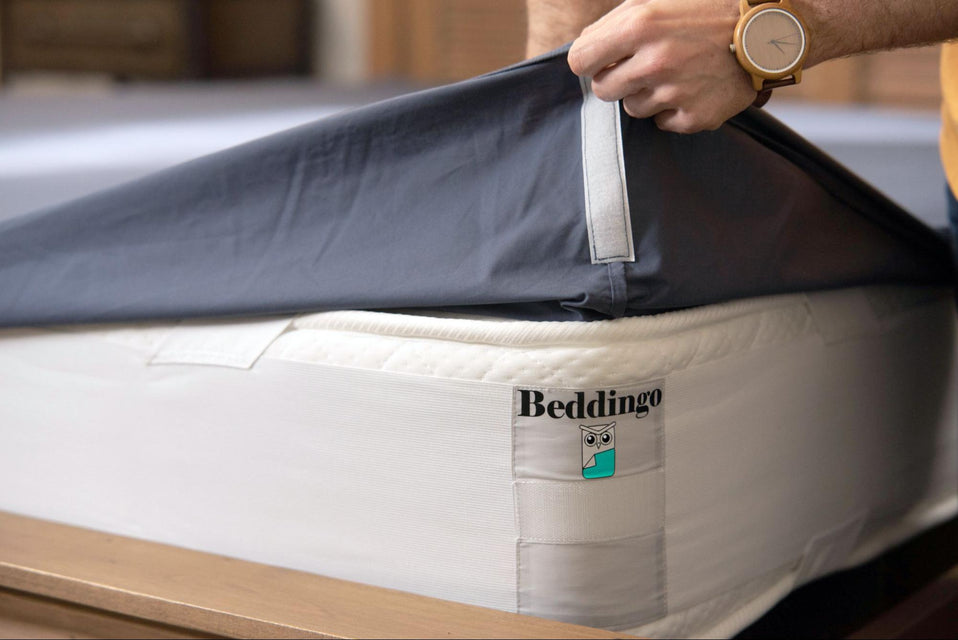
This is the idea behind the Beddingo sheet system.
A Beddingo starter set includes a reusable Beddingo Base that is installed on the mattress and separate sheets that attach to that base.
Once the base is installed, regular sheet changes are designed to happen at the top of the mattress rather than by repeatedly stretching a traditional fitted sheet underneath it.
For someone with a heavy mattress, the important difference isn't simply what the sheet is made from. It's where the work happens when you change it.
With a traditional fitted sheet:
remove corners → access underneath mattress → stretch clean sheet → fit four corners underneath mattress
With the Beddingo system:
leave the reusable base in place → remove the sheet → attach the clean sheet to the existing base
That can be particularly useful when the mattress is difficult to lift or difficult to reach around.
Who Might Benefit From an Easier Sheet-Changing System?
A Thick Mattress
Modern mattresses can be substantially thicker than older mattresses, especially when pillow tops and mattress toppers are involved.
The thicker the mattress, the farther a fitted sheet has to stretch around the corners.
A King-Size Mattress
A larger mattress means larger distances between corners and usually more mattress weight to work around.
Changing a king fitted sheet by yourself can quickly turn into a frustrating process.
A Platform Bed
Some platform beds surround part of the mattress with a raised frame.
This can leave very little room for your hands when trying to pull a fitted sheet underneath.
A Bed Against the Wall
If one side of the bed is inaccessible, changing a traditional fitted sheet often means climbing over the bed, pulling the mattress away from the wall, or repeatedly reaching across it.
Limited Strength or Mobility
There is no reason changing sheets should require more lifting than necessary.
If lifting, bending, stretching, or reaching underneath a mattress is difficult for you, changing the way the sheet attaches may be more useful than simply trying to improve your lifting technique.
Anyone Who Hates Changing Fitted Sheets
You don't need to have a physical limitation to dislike wrestling with fitted sheets.
Sometimes the goal is simply to make a repetitive household chore faster and less frustrating.
What If Your Fitted Sheet Also Keeps Coming Off?
Heavy and thick mattresses create another common frustration: fitted-sheet corners that slip or pop off.
There are several possible causes:
- the sheet pockets are too shallow
- the sheet is the wrong size
- the elastic has weakened
- the mattress surface is slippery
- the sheet is being stretched too tightly
- the mattress and sheet dimensions do not match well
Sheet suspenders and straps can sometimes help keep traditional fitted sheets in position.
However, many of these solutions attach underneath the mattress.
That can create an interesting problem: you may successfully stop the sheet from coming loose, but make the sheet even harder to remove when laundry day arrives.
For someone primarily concerned with a heavy or difficult-to-access mattress, it is worth considering both sides of the problem:
Will the sheet stay in place?
and
How difficult will it be to remove and replace?
The Goal Isn't Better Mattress Lifting
If you have a heavy mattress, there are certainly ways to make traditional bed-making easier.
You can use correctly sized sheets, work one corner at a time, start with difficult-to-reach areas, or use tools that create temporary space under the mattress.
All of these approaches can help.
But there is also a more fundamental option: reduce how often the mattress needs to be lifted in the first place.
A sheet-changing system such as Beddingo approaches the problem by separating the part that stays attached to the mattress from the part you regularly remove and wash.
That means the difficult setup can stay in place while routine sheet changes become simpler.
For people who regularly struggle with a heavy mattress, thick mattress, tight bed frame, or hard-to-reach corners, that difference can matter much more than it first appears.
Frequently Asked Questions
Can you change sheets without lifting the mattress?
It depends on the type of bedding you use.
Traditional fitted sheets generally need to wrap underneath the corners of the mattress, so some lifting or access underneath is usually required.
Alternative sheet systems that use a reusable base or attachment layer can reduce the need to repeatedly lift the mattress during normal sheet changes.
What is the easiest way to put sheets on a heavy mattress?
If you use a traditional fitted sheet, start with the hardest-to-reach corners, work one corner at a time, and make sure the pocket depth matches your mattress.
A mattress-lifting tool can also create temporary space underneath.
If mattress lifting itself is the main problem, consider a sheet system designed so the regularly washed sheet can be changed without repeatedly wrapping it underneath the mattress.
Why is the last corner of my fitted sheet so hard to put on?
By the time you reach the final corner, the sheet is already under tension from the other three.
If the sheet is slightly too small or too shallow for the mattress, that tension becomes even greater.
Checking the mattress dimensions and sheet pocket depth can help.
Are deeper fitted sheets easier to put on?
They can be if your current sheet is too shallow for the mattress.
However, deeper pockets do not eliminate the need to reach underneath the mattress.
They solve a fit problem rather than changing the way the fitted sheet attaches.
Is there an alternative to a traditional fitted sheet?
Yes.
There are bedding systems that separate the mattress attachment component from the washable sheet.
Beddingo, for example, uses a reusable base with separate sheets that attach to it, allowing the base to remain installed between regular sheet changes.
Make the Bed Work for You
Changing your sheets is something you may do dozens of times every year.
If the process repeatedly involves lifting a heavy mattress, stretching into awkward corners, or fighting with elastic fitted sheets, it may be worth questioning the system rather than simply accepting the struggle.
Sometimes the easiest mattress to lift is the one you don't have to keep lifting.


Leave a comment